A sideways pitch can remain live after it hits the turf. To understand an NFL lateral, compare the yard line where the ball leaves the passer's hand with the yard line where it first touches a player or the ground.
The yard-line test
Rule 3-21-4 defines a backward pass using those two locations. First contact parallel to or behind the release yard line makes it a backward pass. A pass does not need to travel visibly toward the passer's own end zone. A truly sideways throw qualifies too.
For a hypothetical example, a runner releases at the 40 while moving upfield. If the ball first reaches a teammate at the same 40-yard line, it is backward under this definition. If it first reaches the teammate at the 41 in the attacking direction, the throw is forward. The runner's body motion and the television camera angle can make the distinction harder to see.
A dropped lateral stays available
Rule 8-7-1 allows either team to catch a backward pass or recover it after it touches the ground and then advance. That explains why players keep chasing a dropped pitch. The ball has not become an incomplete forward pass merely because the intended recipient missed it.
A runner may throw backward at any time under this rule. A snap from center is also a backward pass. When discussing a bad snap, begin with that classification before applying restrictions written specifically for fumbles.
A deflection does not relabel the pass
The rulebook preserves the original forward or backward designation if the pass is batted, muffed, punched or kicked. A backward pass that ricochets forward off a hand does not become a forward pass simply because of the rebound. Other rules can still make the deliberate bat or kick a foul.
Out of bounds has a separate consequence
A backward pass out of bounds between the goal lines is placed at the inbounds spot. During a play that begins after the two-minute warning, a backward pass that goes out of bounds before a possession change also carries a five-yard penalty and loss of down under Rule 8-7-2. It is therefore a poor substitute for stopping the clock with a legal incomplete forward pass.
Watch release, first touch, recovery and boundary in that order. Each answers a separate part of the ruling.
Related rules and sources
Read our NFL catch requirements and fumbles at the end zone for related situations.
This explanation follows Rule 3-21-4 and 8-7-1–2 in the official 2026 rules PDF, checked November 23, 2026, PT. The NFL rulebook index locates related provisions, and the NFL football glossary defines basic terms. Hypothetical examples are illustrations of the rules.
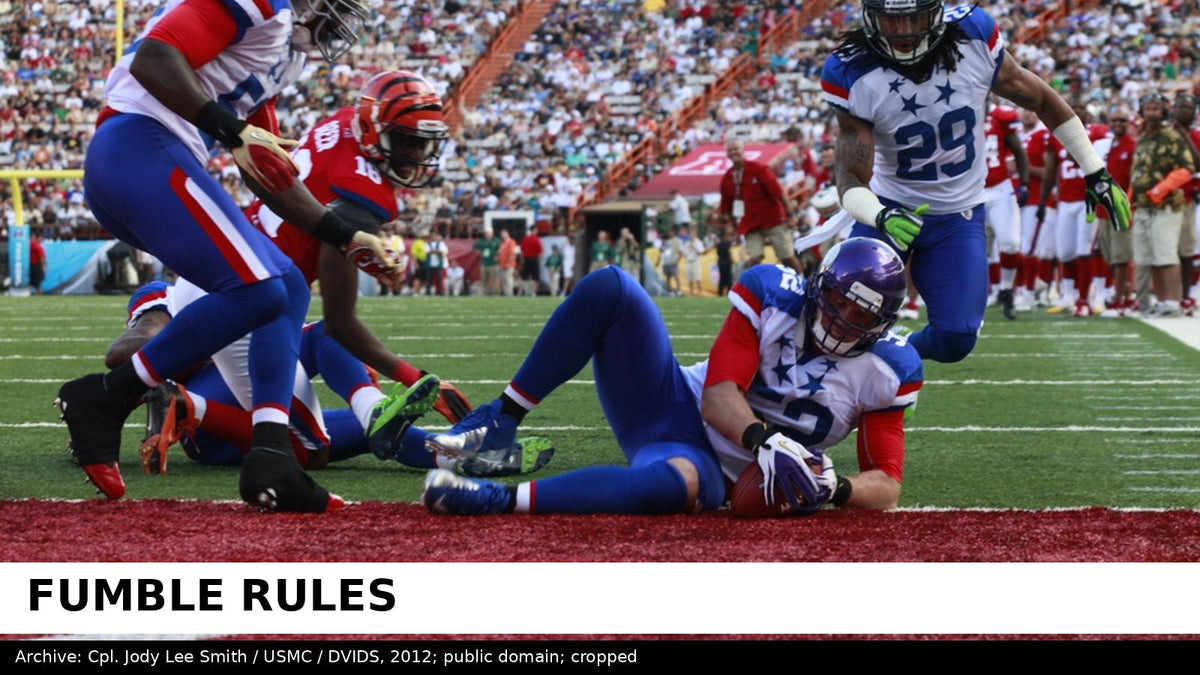
Archive photo: Cpl. Jody Lee Smith, U.S. Marine Corps, 2012 Pro Bowl recovery, public domain in the United States; cropped with a banner. The image illustrates a loose-ball recovery and does not depict every scenario discussed. The appearance of U.S. Department of War visual information does not imply or constitute endorsement.