Knocking a football away can be legal on one play and a penalty on the next. The NFL considers the type of loose ball, whether it has touched the ground, its location and the direction of the deliberate contact.
Forward pass deflections
Rule 12-5-1 permits an eligible player to tip, bat or deflect a forward pass in flight in any direction. A defensive back swatting an airborne pass away from a receiver is a familiar application. The rule does not provide the same blanket permission for every ball bouncing around the field.
Grounded loose balls and end zones
In the field of play, batting or punching a loose ball toward the opponent's goal line is illegal. In either end zone, batting or punching a loose ball that has touched the ground is illegal in any direction. An offensive player also may not bat a backward pass in flight toward the opponent's goal line.
Picture a hypothetical runner losing the ball near the sideline. A teammate who deliberately punches the loose ball toward the opponent's goal line has done something different from trying to secure a recovery. Moving the ball out of immediate danger does not by itself make that action legal.
For an end-zone scramble, first establish whether the ball has touched the ground. That detail matters to the end-zone batting restriction. Do not apply the legal airborne forward-pass exception to a ball already bouncing across the goal area.
A deliberate kick is also restricted
Rule 12-5-2 prohibits deliberately kicking a loose ball or a ball in another player's possession. A ball accidentally striking a foot is not automatically proof of a deliberate kick. The official must judge the action. An illegal kick does not itself make the recovered ball dead; another rule may end the play.
Penalty and possession details
The listed penalty is ten yards. A foul by the original offense before a possession change during a scrimmage down also generally costs a down, with a specific exception for its foul beyond the line during a scrimmage kick. The enforcement spot depends on the play and applicable penalty rules.
If an opponent bats or illegally kicks the ball into a player, Rule 12-5-3 generally disregards that player's resulting touch. That can matter when a kick's first touching or possession rights are being sorted out. Follow the referee's full explanation instead of treating every contact with the ball as the same event.
Related rules and sources
Read our end-zone fumble explanation and offsetting penalty rules for related situations.
This explanation follows Rule 12-5-1–3 in the official 2026 rules PDF, checked November 23, 2026, PT. The NFL rulebook index locates related provisions, and the NFL football glossary defines basic terms. Hypothetical examples are illustrations of the rules.
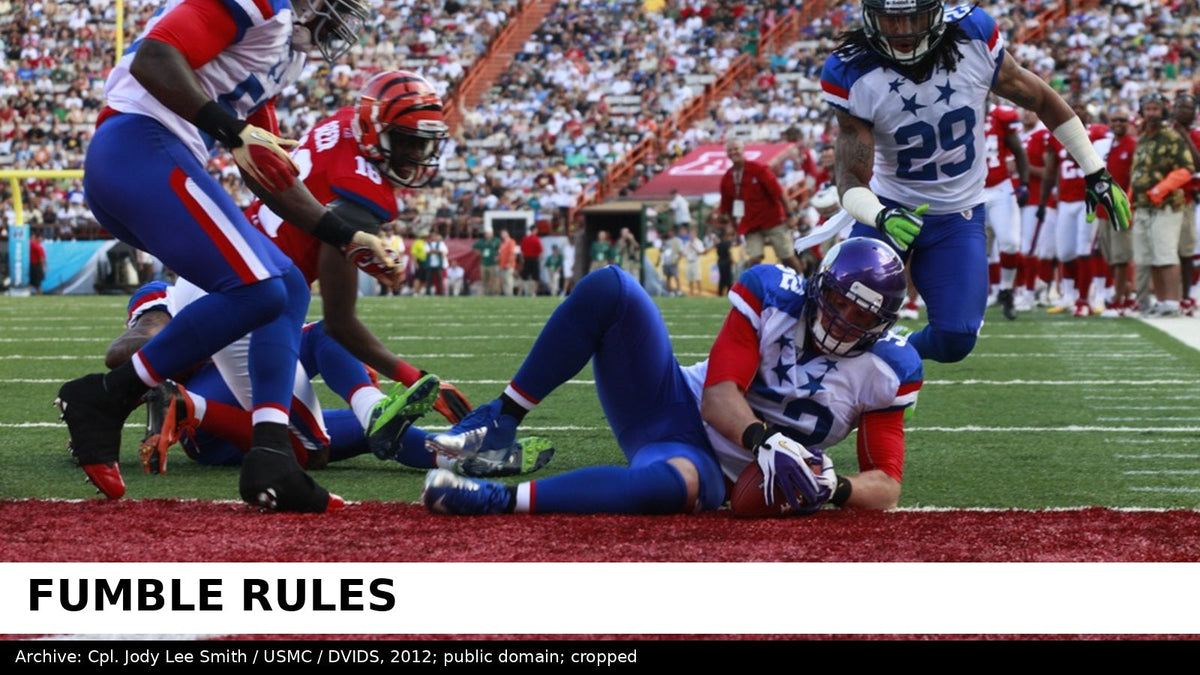
Archive photo: Cpl. Jody Lee Smith, U.S. Marine Corps, 2012 Pro Bowl recovery, public domain in the United States; cropped with a banner. The image illustrates a loose-ball recovery and does not depict every scenario discussed. The appearance of U.S. Department of War visual information does not imply or constitute endorsement.