21+ only. Gambling problem? Call 1-800-GAMBLER. Sports betting is legal only in some states, and the rules differ by state. Check your state's law before you place any bet.
Implied probability turns betting odds into a percentage: the chance of an outcome that the price assumes. It is the most useful number for reading a line, because it lets you compare odds in different formats and see what a bet has to hit to break even. This post covers the formulas, three worked examples, and why the two sides of a market add up to more than 100%.
The two formulas for American odds
American odds come in two forms, so there are two formulas.
Negative odds (the favorite)
Implied probability = odds / (odds + 100), using the number without its minus sign.
Positive odds (the underdog)
Implied probability = 100 / (odds + 100).
Worked examples
Example: -110 odds
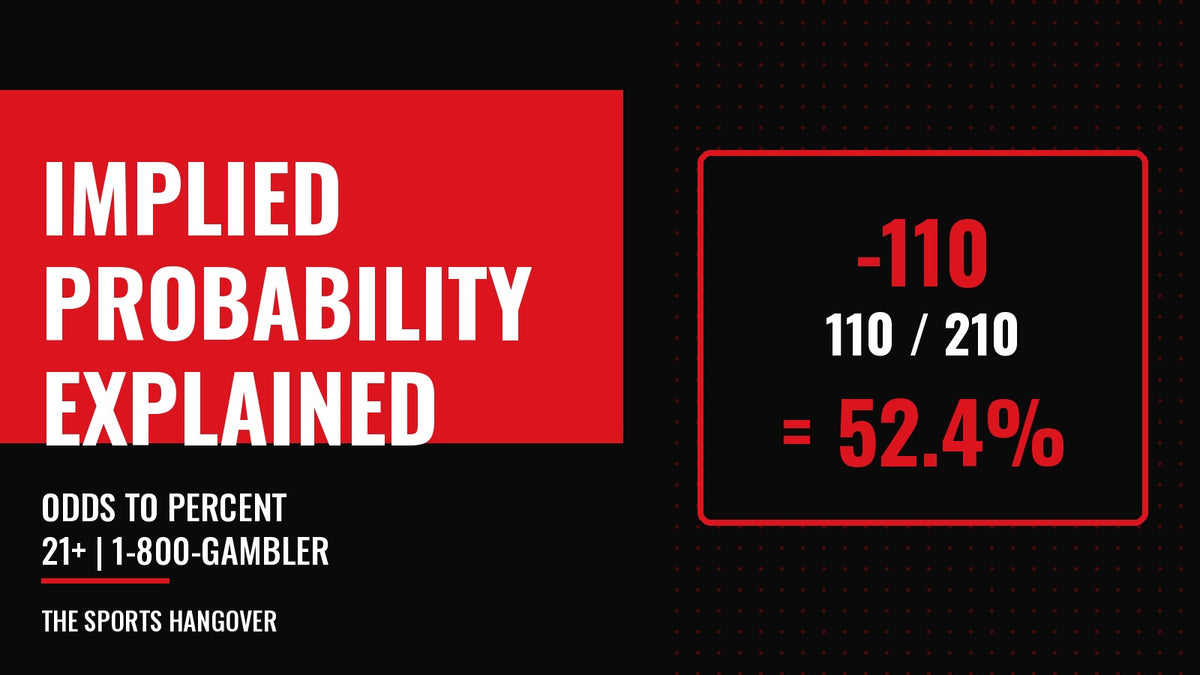
110 / (110 + 100) = 110 / 210 = 0.524, or 52.4%. At -110 you risk $110 to win $100, so you need to win 52.4% of those bets to break even.
Example: +150 odds
100 / (150 + 100) = 100 / 250 = 0.40, or 40.0%. You risk $100 to win $150.
Example: -150 odds
150 / (150 + 100) = 150 / 250 = 0.60, or 60.0%. You risk $150 to win $100.
| American odds | Risk / win | Math | Implied probability |
|---|---|---|---|
| -150 | $150 to win $100 | 150 / 250 | 60.0% |
| -110 | $110 to win $100 | 110 / 210 | 52.4% |
| +100 | $100 to win $100 | 100 / 200 | 50.0% |
| +150 | $100 to win $150 | 100 / 250 | 40.0% |

Why both sides add up to more than 100%
Take a standard spread priced at -110 on both sides. Each side implies 52.4%, so together they come to about 104.8%. The extra 4.8 points is the bookmaker's margin, often called the vig or juice. It's the reason a bettor has to beat 50% just to break even.
To estimate a "fair" probability without the margin, divide each side's implied probability by the total. At -110 / -110 that gives 52.4 / 104.8 = 50% per side. With uneven prices, such as -150 and +130, the same method gives the market's estimate for each side once the margin is removed: 60.0% and 43.5% add up to 103.5%, so the no-vig estimates are about 58.0% and 42.0%.
How to use implied probability
Implied probability is a way to compare. If your own estimate of an outcome is lower than the price implies, the bet costs more than you think it's worth. If it's higher, the price looks better to you, but only if your estimate is reliable, and most aren't.
That's how our weekly research posts are framed. In the Panthers-Packers Week 8 post, the model gave Carolina +3.5 a 53.1% chance to cover, against the 52.4% needed at -110. That gap was too thin to act on, and the verdict was pass. The same model went 48.7% against closing lines in its 2021-25 backtest. That is not a proven edge, and it's a reminder that a model's percentages are estimates, not facts.
For how spread bets are graded, see What Does Against the Spread Mean? For the basics of spreads and moneylines, see How Does Sports Betting Work?, and for the long-run math, Can Sports Betting Be Profitable?
Frequently asked questions
What is the implied probability of -110?
52.4%. The math is 110 divided by 210.
How do you convert positive odds to a probability?
Divide 100 by the odds plus 100. At +150, that is 100 / 250 = 40%.
Is implied probability the true chance of winning?
No. It is the chance the price assumes, including the bookmaker's margin. Removing the margin gives a better estimate of the market's view, but it is still an estimate.
Research and education only. Nothing here is betting advice. All percentages above are computed from the formulas shown and rounded to one decimal. Legal status by state: American Gaming Association state gaming map. Help: National Council on Problem Gambling.
21+ only. Gambling problem? Call 1-800-GAMBLER. Sports betting is legal only in some states. Check your state's law. Bet only what you can afford to lose.
The Sports Hangover