21+ only. Gambling problem? Call 1-800-GAMBLER. Sports betting is legal only in some states, and the rules differ by state. Check your state's law before you place any bet.
Updated October 31, 2026
Closing line value, usually shortened to CLV, compares the price you took on a bet with the final price the market posted before the game started. If your number was better than the closing number, you had positive CLV. If it was worse, you had negative CLV. This post explains what the closing line is, how CLV is measured on spreads and on odds, and what the measure can and cannot tell you.
What is the closing line?
The closing line is the last spread or price a sportsbook offers before an event begins. Lines move during the week as information arrives, such as injury reports and weather, and as money comes in. By kickoff, the line reflects all of that. Pinnacle, a sportsbook that publishes education material on the topic, compares it to a stock's closing price: if you bought at $90 and the stock closed at $100, you paid less than the market's final valuation (Pinnacle, What Is Closing Line Value).
That is the logic behind CLV. The closing line is treated as the market's most informed estimate, so beating it repeatedly suggests you were getting prices ahead of where the market finished.
How closing line value is measured
On point spreads
With spreads, CLV is often described in points. Pinnacle's example: if you bet an NFL favorite at -2.5 and the line closed at -3.5, you got a better number than the close, because your team only had to win by 3 while later bettors needed a 4-point win. That is positive CLV. If you took -3.5 and it closed at -2.5, that is negative CLV.
The same idea runs the other way for underdogs. Taking +3.5 on an underdog that closes at +2.5 means you got an extra point compared with the final market.
On odds and moneylines
With prices, CLV is usually expressed as a percentage. A common formula, used by several betting analytics sites, is your decimal odds divided by the closing decimal odds, minus 1 (Pinnacle Terminal, CLV explained).
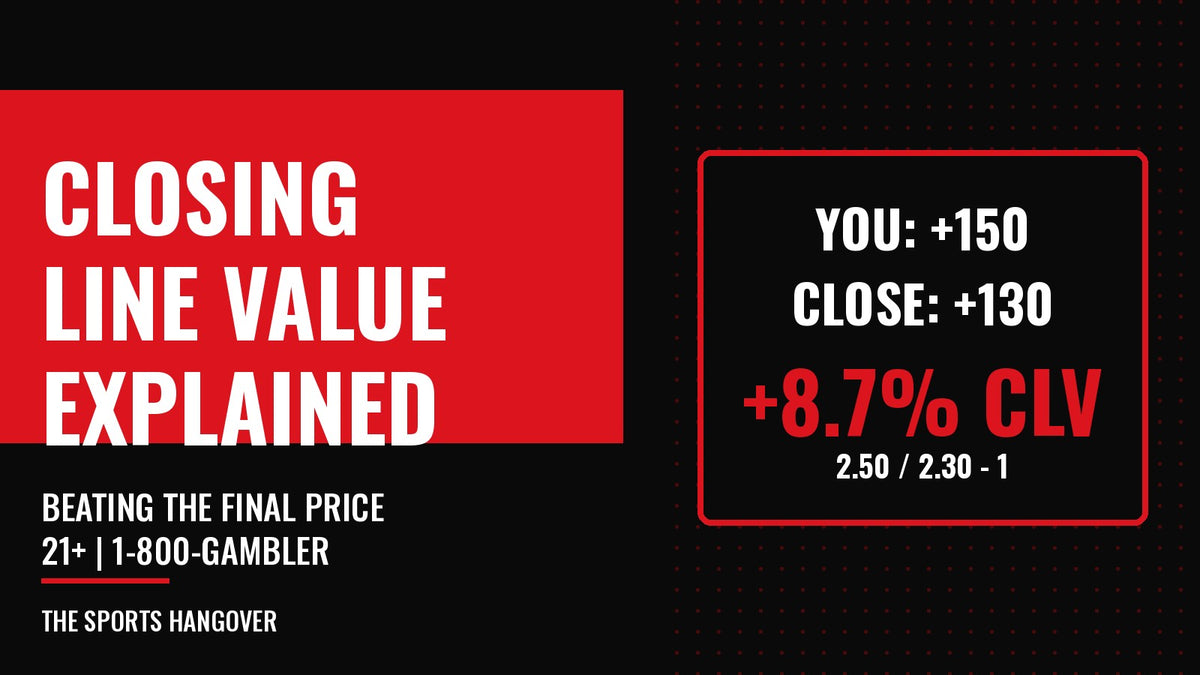
Example: you bet an underdog at +150 (decimal 2.50) and it closes at +130 (decimal 2.30). The math is 2.50 / 2.30 - 1 = 0.087, or about +8.7% CLV. In implied probability terms, +150 implies 40.0% and +130 implies 43.5%. The market finished more confident in that team than the price you paid assumed.
Using a no-vig closing price
A closing price still includes the bookmaker's margin. Some bettors remove it first so they compare against a "fair" close. Say the close was -150 on the favorite and +130 on the underdog. Those imply 60.0% and 43.5%, which add up to 103.5%. Dividing the underdog's 43.5% by 103.5% gives a no-vig estimate of about 42.0%, or fair decimal odds of about 2.38. Against that fair close, the +150 ticket shows about +5.0% CLV (2.50 / 2.38 - 1). We walk through the margin-removal step in What Is Implied Probability in Sports Betting?
| Your bet | Close | Method | CLV |
|---|---|---|---|
| Favorite -2.5 | -3.5 | Points | +1 point (positive) |
| Favorite -3.5 | -2.5 | Points | -1 point (negative) |
| Underdog +150 (2.50) | +130 (2.30) | Odds vs. raw close | +8.7% |
| Underdog +150 (2.50) | +130, no-vig fair 2.38 | Odds vs. fair close | +5.0% |
All percentages in the table are computed from the formulas above and rounded to one decimal.

Why bettors track CLV
A single bet's result is mostly noise. A team can be the right side at the price and still lose. CLV gives a second measure that does not depend on the final score, so it can be checked after every bet instead of waiting hundreds of games for results to settle.
Pinnacle describes consistent positive CLV as one of the strongest indicators that a bettor is getting better prices than the general public, and says recreational sportsbooks use it when deciding whether to limit an account. That is the sportsbook's view, not a rule, and there is no official threshold for how much CLV is "enough."
What CLV does not tell you
It is not profit
CLV measures price, not results. It is also not the same thing as expected value, a point made in Statometrics' guide to closing line value. Positive CLV only points toward positive expected value if the closing line is a good estimate of the true probability, and that is an assumption, not a fact.
Small samples mislead
A handful of bets with good CLV says very little. Analysts who use the measure look at averages over a large number of bets, and even then the result is an estimate.
It is easy to measure wrong
Comparing against a closing number from a different sportsbook, using a stale line, or ignoring the margin will all change the answer. Write down the exact price and the time you bet it, then record the close from the same source each time.
How we use it at The Sports Hangover
Our own research model is graded against closing lines. The research model behind our weekly posts went 48.7% against closing lines in its 2021-25 backtest. That's not a proven edge. You can see how the model's numbers are framed in our Panthers-Packers Week 8 research post, how spreads are graded in What Does Against the Spread Mean?, and the long-run math in Can Sports Betting Be Profitable?
Frequently asked questions
What does positive CLV mean?
It means the price or spread you bet was better than the final price before the game. Taking -2.5 on a favorite that closes at -3.5 is positive CLV.
How do you calculate closing line value?
For prices, divide your decimal odds by the closing decimal odds and subtract 1. At 2.50 against a 2.30 close, that is about +8.7%. For spreads, count the points between your number and the closing number.
Does beating the closing line mean you will win money?
No. CLV is a measure of price, not a result. It can point in the right direction over a large sample, but it does not guarantee a profit on any bet or over any stretch.
Research and education only. Nothing here is betting advice. Sources: Pinnacle, What Is Closing Line Value (CLV) in Sports Betting?; Pinnacle Terminal, Closing Line Value Explained; Statometrics, Closing Line Value. Legal status by state: American Gaming Association state gaming map. Help: National Council on Problem Gambling.
21+ only. Gambling problem? Call 1-800-GAMBLER. Sports betting is legal only in some states. Check your state's law. Bet only what you can afford to lose.
The Sports Hangover