A muff happens when a player touches a loose ball while trying to gain possession and fails to secure it. A fumble happens after possession has been established. That difference can determine whether a kicking-team recovery ends the play or produces a return.
Possession is the first question
The NFL rulebook possession definitions, Rule 3, Section 2, distinguish touching from controlling the ball. A ball bouncing off a returner's hands does not by itself establish possession. Officials must determine whether the player controlled it inbounds and satisfied the possession requirements.
Watch the entire action. A still image of two hands around the ball can miss a bobble, an out-of-bounds step or the moment control was lost. The same attention to control matters when deciding what counts as a catch.
Why the distinction matters on a punt
Under Rule 9, a kicking team can recover a punt that the receiving team first touches beyond the line of scrimmage. When the receiver merely muffs that kick, the kicking team cannot advance its recovery. The recovery itself can still change possession and give the kicking team a new series.
If the returner first establishes possession and subsequently fumbles, the ball is loose following a fumble. The recovery and advancement rules then follow that different classification. Calling every dropped punt a fumble skips the fact that decides which rules apply.
A hypothetical return example
A returner reaches for a punt at his own 25-yard line. The ball glances off his hands and falls to the turf before he controls it. A coverage player recovers at the 23. That is a muffed punt: the coverage team takes possession at its recovery spot, with no advance.
Change the sequence. The returner secures the punt, completes the possession requirements, starts upfield and then loses the ball. Officials now have a fumble to judge. The key change is the established possession between the kick and the loose ball.
These examples assume no foul, fair-catch complication or other special circumstance. A valid fair-catch signal creates additional protections and restrictions that need their own review.
Replay can change the classification
The 2026 rulebook's replay casebook, examples 15.35 and 15.36, specifically addresses muff versus fumble on a punt. It allows review of whether possession existed, but an official's dead-ball ruling can limit the advance that may be awarded afterward. A replay correction therefore does not always recreate the return a player tried to make after the whistle.
For a disputed play, identify the original ruling, the possession sequence and when the ball was declared dead. That gives a more useful explanation than treating every replay reversal as the same event.
Terms to keep separate
The NFL football terms guide provides broader context for following possession and kicking plays. The official rulebook index links the governing rules. For this question, start with possession, then determine whether the loose ball remains a kick or follows a fumble, and finally apply the recovery rule.
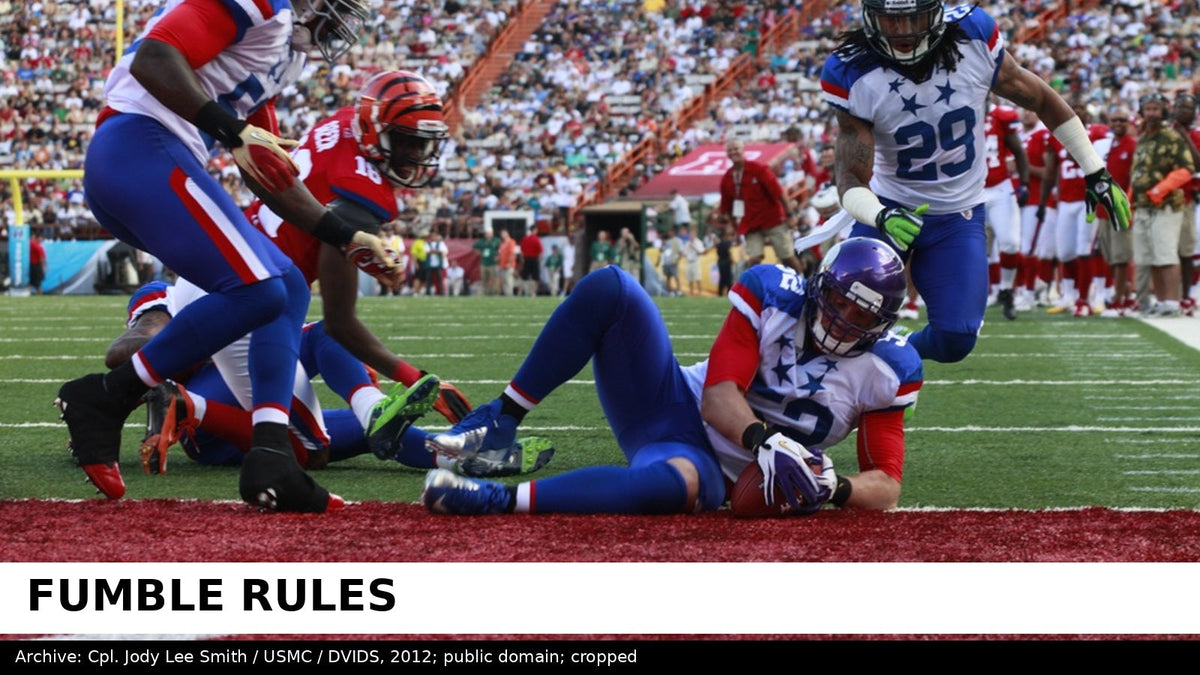
Archive photo: Chad Greenway recovering a fumble at the 2012 Pro Bowl. Cpl. Jody Lee Smith / USMC, via DVIDS Pro Bowl photograph, public domain; cropped. The photograph illustrates a fumble recovery and does not depict the hypothetical punt examples.