Updated November 3, 2026
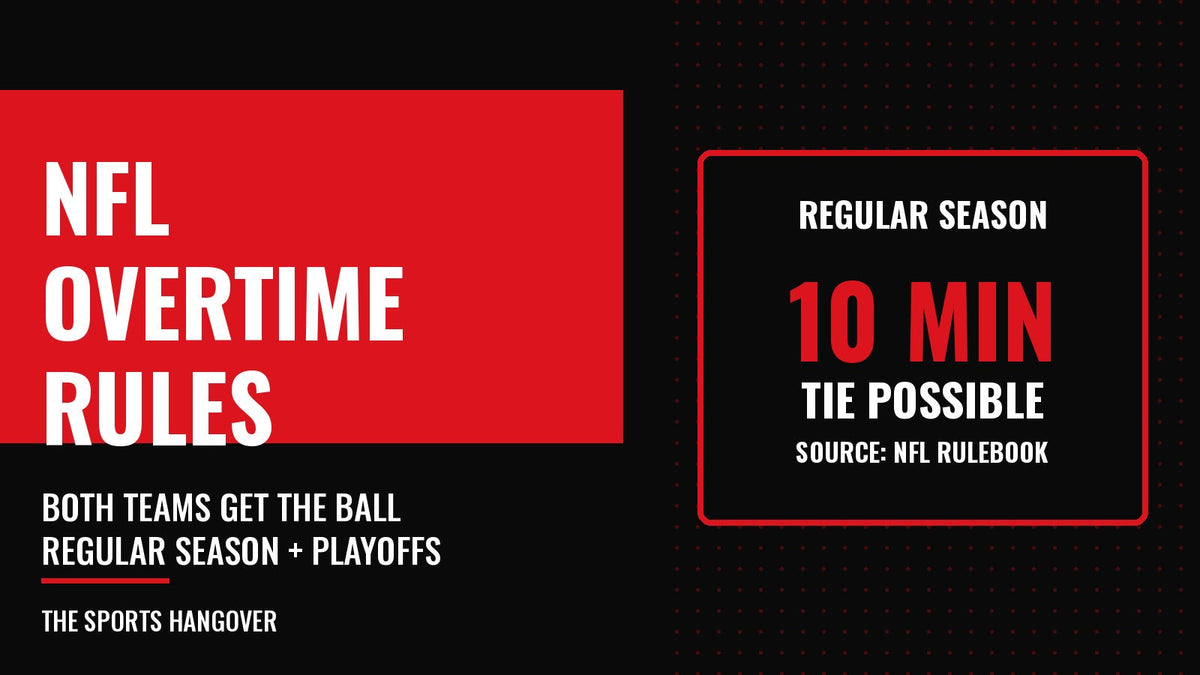
NFL overtime in the 2026 regular season is one 10-minute period in which both teams get a chance to possess the ball, even if the first team scores a touchdown. If the score is still tied when the 10 minutes run out, the game ends in a tie. Playoff overtime uses the same possession rule but keeps playing 15-minute periods until someone wins. This guide walks through each rule as written in the NFL's 2026 official playing rules (Rule 16, Overtime Procedures), how the format changed, and how two Week 8 overtime games played out under it.
How does NFL overtime start?
At the end of regulation, the referee tosses a coin at midfield, and the visiting team's captain calls it, under Rule 16, Section 1, Article 2. The winner gets the same choice as at the opening toss, such as whether to receive or kick. Overtime begins after an intermission of no more than three minutes.
What are the regular-season overtime rules?
Rule 16, Article 3 sets out the regular-season format:
- One 10-minute period. There is a maximum of one period, even if the second team has not had its chance to possess the ball or its first possession has not ended.
- Both teams get a chance. Each team must have the opportunity to possess the ball once. A touchdown on the opening drive does not end the game.
- One exception. If the team that kicks off to start overtime scores a safety on the receiving team's first possession, the kicking team wins.
- After both possessions, the leader wins. If one team has more points once each side has had its opportunity, that team wins.
- Then it is sudden death. If the first team does not score, or the score is tied after both possessions, the next score by any method wins.
- Two timeouts each. Fourth-quarter timing rules apply.
- Ties are possible. If the score is level at the end of the period, the game is recorded as a tie.

What counts as a possession in overtime?
The rulebook defines the "opportunity to possess" through kicking plays. A kickoff counts as the receiving team's opportunity. If the kicking team legally recovers its own kick, the receiving team is still considered to have had its chance. A punt or field goal attempt that crosses the line of scrimmage and is muffed by the receiving team also counts as an opportunity for that team.
Can a team still win on the first drive?
Not with an offensive score. A touchdown or field goal on the opening drive only puts the second team in a must-score spot. The rulebook's explicit exception is the safety above. A defensive touchdown on that opening possession also ends the game: the interception or fumble gives the kicking team its possession, and the score puts it ahead, as NBC Sports' ProFootballTalk overtime explainer notes. Article 5(a) also covers a related case: if the first team scores and the second team then loses the ball on an interception or fumble, the down is played to its end and any points scored on that play count.
Why does the 10-minute clock matter?
Because the regular-season period is capped at 10 minutes, a long opening drive can leave the second team little time, and the game can end without the second team finishing its possession. NFL.com noted when the 2025 change passed that the shorter period could push a team that answers an opening touchdown with one of its own to go for two and the win, since there may not be time for another possession. That is a coaching decision, not a rule, but it follows directly from the clock.
How is playoff overtime different?
Rule 16, Article 4 covers the postseason. The possession rules are the same, including the safety exception and next-score-wins once both teams have had the ball. The differences are about time:
- Each period is 15 minutes, and play continues for as many periods as needed. Playoff games cannot end in a tie.
- There is a two-minute intermission between periods and no halftime after the second period.
- Each team has three timeouts per half, as in regulation, instead of two for the whole overtime.
- End-of-half timing applies at the end of the second overtime period, and end-of-game timing at the end of the fourth.
- If the game is still tied after a fourth overtime period, there is another coin toss.
Rules that apply in all overtime games
Article 5 lists rules for both formats. Coaches cannot challenge plays; all replay reviews are started by the replay official. A player disqualified during the game cannot return in overtime.
How did NFL overtime rules change?
According to NFL.com's 2025 rule changes explainer, the league added regular-season overtime in 1974 as a 15-minute sudden-death period. Regular-season overtime was cut to 10 minutes in 2017. In 2022 the league guaranteed both teams a possession in the playoffs only. On April 1, 2025, clubs approved a version of a Philadelphia proposal that applied that rule to the regular season, as recorded in the NFL's approved 2025 playing rules. Philadelphia had also proposed going back to a 15-minute period, but the league kept 10 minutes. The 2026 rulebook keeps the same format.
The same NFL.com article cited Sportradar data showing that in the 2024 season, six of 16 overtime games ended on an opening-drive touchdown, and teams that won the overtime coin toss won 75 percent of the time.
How did the rules play out in Week 8 of 2026?
Two games went to overtime on Sunday, November 1, as our full Week 8 recap lists. The Cardinals beat the Cowboys 33-30, and the Bengals beat the Titans 43-36.
The Arizona game shows the possession rule step by step. According to the Cowboys' game recap, Dallas won the toss and chose to play defense first. Arizona went three-and-out, then Dallas punted on its first possession. With both teams having had the ball and the score still tied, the next score would win, and Chad Ryland's 42-yard field goal ended it. In Cincinnati, Joe Burrow's touchdown run in overtime decided the game, as NFL.com's Bengals-Titans story covers.
Related: our guide to how the practice squad works, plus the Week 9 schedule and TV guide for this week's games.
Questions About NFL Overtime
Do both teams get the ball in NFL overtime?
Yes. Both teams must have the opportunity to possess the ball, even if the first team scores a touchdown. The rule has applied in the playoffs since 2022 and in the regular season since 2025. The exception is a safety by the kicking team on the receiving team's first possession, which ends the game.
How long is overtime in the NFL regular season?
One 10-minute period. If the score is still tied at the end of it, the game ends in a tie. In the playoffs, overtime periods are 15 minutes and continue until there is a winner.
Can coaches challenge plays in NFL overtime?
No. Coaches' challenges are not allowed in overtime. All replay reviews are initiated by the replay official.
Sources: NFL, 2026 official playing rules (Rule 16 and Rule 4-5); NFL Football Information, approved 2025 rules (April 1, 2025); NFL.com, 2025 rules changes; DallasCowboys.com, Cardinals-Cowboys recap; NFL.com, Bengals-Titans. Checked November 3, 2026.