A quarterback aligned immediately behind the center can legally stop the clock by receiving the snap and throwing directly into the ground in one continuous motion. Rule 8-2-1 provides this specific clock-saving exception. Waiting to see whether a play develops before spiking is a different situation.
What makes the immediate spike legal?
The rule applies to a T-formation quarterback, defined as a player aligned no more than one yard behind the snapper. The throwing motion must begin immediately upon receiving the snap. That is why the familiar hurry-up sequence has the quarterback take the snap under center and drive the ball straight down.
Do not extend this exception to every hurried throw into the turf. Alignment, timing and the continuous motion matter. The full intentional grounding rule governs other attempts to discard a pass.
The cost is a down
A legal spike is an incomplete pass. It stops the clock but uses the current down. In a hypothetical second-and-6 situation, a legal spike leaves third-and-6. On fourth down, deliberately throwing an incomplete pass would give up possession.
That tradeoff matters when an offense has only a few chances left to reach field-goal range. Before shouting for a spike, check the down, the remaining time and whether the team has a timeout. Our NFL clock guide explains other stoppages.
Why a delayed spike can be grounding
Rule 8-2-1 expressly prohibits delaying the passing action for strategic purposes and then throwing into the ground in front of the passer. The prohibition applies even without pressure from a defensive rusher. A quarterback cannot use the immediate-spike exception as a backup after taking a look at the defense.
A failed exchange also requires care: seeing the ball bounce does not establish that a pass was thrown. Watch possession and the throwing action before assuming the clock stopped on an incompletion.
A quick viewing checklist
- Was the quarterback aligned close enough to the center?
- Did the throwing motion begin immediately after the snap?
- Was it continuous, with the throw directly into the ground?
- What down remains after the incompletion?
A clean legal spike is a clock-management choice. A delayed spike can add a penalty, and late-half timing rules can make that mistake more costly.
Checked November 26, 2026 against the 2026 NFL playing rules and casebook, the NFL rulebook index and the NFL football terms guide. Examples are hypothetical and apply to NFL rules.
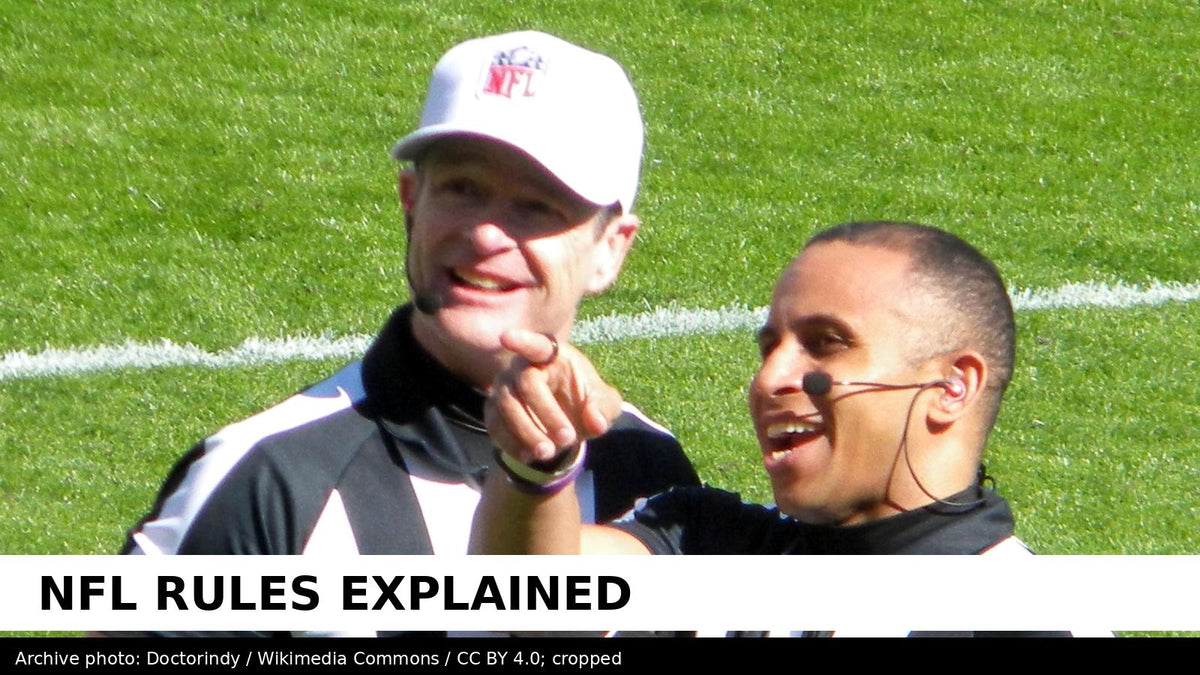
Archive photo: NFL officials Land Clark and Dominique Pender, December 31, 2023. Doctorindy via Wikimedia Commons, CC BY 4.0; cropped with a banner. The photograph illustrates officiating, not the example plays.