Updated November 3, 2026
21+ only. Sports betting is not legal in every state. Check your local laws. Problem gambling? Call 1-800-GAMBLER.
The moneyline is the simplest bet on a sports menu, and the numbers still trip people up the first time. This guide explains what the numbers mean, how payouts work, how a moneyline differs from a point spread, and how to turn the odds into an implied probability. Every dollar figure below is a made-up round-number example, not a current line on any game.
The Moneyline in One Sentence
A moneyline bet is a wager on which team wins the game outright. Margin of victory does not matter. The Tennessee Sports Wagering Council's glossary defines it as "a wager on the outcome of a sporting event outright, with fixed odds in relation to the dollar amount wagered." If your team wins by one point or by 30, a winning moneyline ticket pays the same amount.
Reading Favorites and Underdogs: the Minus and Plus Signs
American odds use a minus sign for the favorite and a plus sign for the underdog.
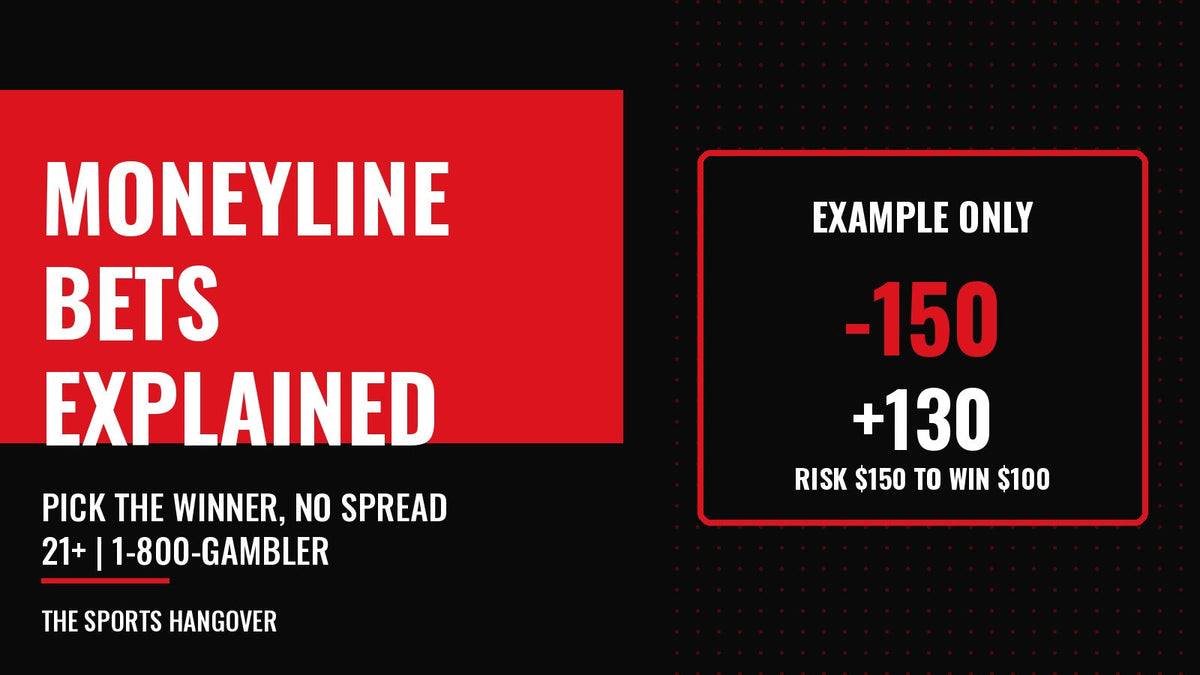
- Minus number (favorite): how much you would need to risk to win $100. At -150, you risk $150 to win $100.
- Plus number (underdog): how much you would win on a $100 risk. At +130, a $100 bet wins $130.
When both sides are listed near -110, sportsbooks often call the game a pick'em, meaning neither team is a clear favorite. The Tennessee glossary also defines the vigorish, or "juice," with the example of wagering $110 to win $100; the $10 difference is the book's fee.
How Moneyline Payouts Are Calculated
Two formulas cover every American moneyline. The result is profit; a winning ticket also returns your original stake.
- Favorite: profit = stake x 100 / odds (ignore the minus sign). Example: $100 at -150 gives $100 x 100 / 150 = $66.67 profit, or $166.67 back in total.
- Underdog: profit = stake x odds / 100. Example: $100 at +130 gives $100 x 130 / 100 = $130 profit, or $230 back in total.
The chart below shows the same hypothetical game from both sides.

Notice the asymmetry. Backing the favorite risks more to win less, because the favorite is expected to win more often. Neither side is a "better" bet on its own. Whether a price is worth taking depends on how often that team actually wins, which nobody knows in advance.
Moneyline vs. Point Spread
A point spread bet asks a different question: will a team win by more than a set margin, or lose by less than it? The Tennessee glossary describes the spread as "the predicted scoring differential" between the two teams. A 3-point favorite on the spread must win by more than 3 for the bet to win; on the moneyline, that same team only has to win. Our explainer on what against the spread means covers spread grading, pushes and the hook in more detail.
In practice, moneyline prices and spreads move together. A team that is a heavy favorite on the spread will carry a large minus number on the moneyline, and a close game on the spread will show moneylines near even.
Turning Moneyline Odds Into Implied Probability
Every moneyline carries an implied win probability, which is the break-even rate the price requires.
- Favorite: odds / (odds + 100). At -150: 150 / 250 = 60.0%.
- Underdog: 100 / (odds + 100). At +130: 100 / 230 = 43.5%.
Add the two sides of the hypothetical game together and you get 103.5%, not 100%. The extra 3.5 points is the sportsbook's margin built into the prices. At -110 on both sides, each side implies 52.4%, which is why a bettor at -110 has to win more than half the time just to break even. Our guide to implied probability in sports betting walks through removing that margin, and our piece on closing line value explains why the final price before kickoff is the usual benchmark for judging a bet.
A Note on Our Own Research Model
The Sports Hangover publishes model-based research, not picks. Our research model's backtest went 48.7% against closing lines from 2021 to 2025. That's not a proven edge. We share that number so readers can weigh our research accordingly, and nothing on this page is a recommendation to bet.
Where Moneyline Betting Is Legal and Where to Get Help
Legal status depends on where you are. The American Gaming Association's state-by-state map tracks which states allow sports betting. If betting stops being fun, the National Council on Problem Gambling help page lists treatment and support options, and the 1-800-GAMBLER helpline site offers confidential help.
Moneyline Betting: Frequently Asked Questions
What does a moneyline bet mean?
A moneyline bet is a wager on which team wins the game outright, with no point spread. The margin of victory does not change the payout.
How do you calculate a moneyline payout?
For a favorite, profit equals stake times 100 divided by the odds, so $100 at -150 wins $66.67. For an underdog, profit equals stake times the odds divided by 100, so $100 at +130 wins $130.
What is the difference between a moneyline and a point spread?
A moneyline only asks who wins. A point spread asks whether a team wins by more than, or loses by less than, a set number of points.
21+ only. Sports betting is not legal in every state. Check your local laws. Problem gambling? Call 1-800-GAMBLER.